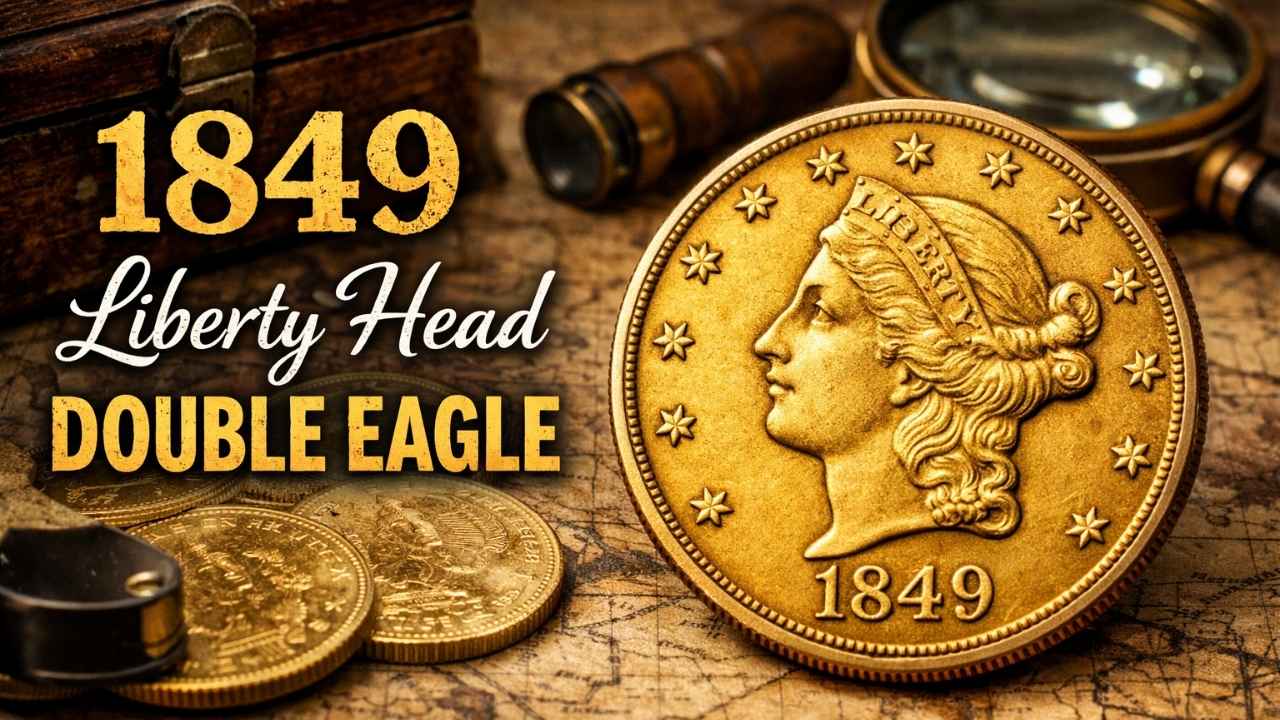
1849 Liberty Head Double Eagle: In the mid-nineteenth century, America was undergoing a transformation. The California Gold Rush had flooded the nation with newfound wealth, and the U.S. Mint sought to create larger denominations to accommodate the influx of gold. Out of this era came the Liberty Head Double Eagle, a twenty-dollar gold coin designed by Chief Engraver James B. Longacre. It was meant to symbolize prosperity, stability, and the growing power of the United States.
The very first of these coins was struck in 1849, but unlike later issues, the inaugural piece was never intended for circulation. Instead, it was a prototype—a coin that would become one of the most legendary rarities in American numismatics.

A Coin Born of Change
Before the Double Eagle, the largest gold coin in circulation was the ten-dollar Eagle. With the sudden abundance of gold, Congress authorized the creation of a twenty-dollar denomination. The Liberty Head design featured Lady Liberty in classical style, surrounded by thirteen stars representing the original colonies. On the reverse, a heraldic eagle carried a shield, arrows, and olive branches, symbolizing both strength and peace.
This design would remain in use for decades, but the very first coin struck in 1849 was unique. It was not just a new denomination—it was a statement of America’s ambition.

The Mystery of the 1849 Prototype
Only one confirmed specimen of the 1849 Liberty Head Double Eagle exists today. It was struck at the Philadelphia Mint and presented to the Secretary of the Treasury. Unlike later issues, this coin was never released to the public. Its rarity lies not only in its limited production but also in its symbolic role as the birth of a new era in American coinage.
Collectors often speak of “key dates” in coin series, but the 1849 Double Eagle is beyond a key date—it is a one-of-a-kind treasure. Its existence bridges the gap between concept and reality, making it a cornerstone of U.S. numismatic history.

Where the Coin Resides
The sole surviving 1849 Double Eagle is housed in the Smithsonian Institution’s National Numismatic Collection. It is not available for private ownership, making it one of the most unattainable coins in the world. For collectors, this adds to its mystique. Unlike other rare coins that occasionally appear at auction, the 1849 Double Eagle is permanently off the market.
Its presence in the Smithsonian ensures that it remains a piece of shared heritage rather than a private possession. Visitors who view it are not just looking at a coin—they are witnessing the dawn of a new chapter in American monetary history.

The Value of Rarity
Because the coin is unique and unobtainable, assigning a market value is nearly impossible. Experts speculate that if it were ever offered for sale, it could command tens of millions of dollars, rivaling the most expensive coins ever sold. Yet its true worth lies in its historical significance rather than its monetary value.
For numismatists, the 1849 Double Eagle represents the pinnacle of rarity. It is a reminder that coins are more than currency—they are artifacts that tell the story of a nation’s growth, struggles, and triumphs.

The Legacy of the Liberty Head Series
After the prototype, the Liberty Head Double Eagle entered full production in 1850. Over the next half-century, millions were struck, circulating widely across the expanding United States. These coins financed trade, fueled westward expansion, and became symbols of American wealth.
Yet none of those countless coins carry the aura of the 1849 specimen. While later issues are collectible and valuable, the first Double Eagle stands apart as the genesis of the series.

Why the 1849 Double Eagle Matters
The story of the 1849 Liberty Head Double Eagle is not just about rarity—it is about timing, symbolism, and the spirit of innovation. It embodies the optimism of a nation riding the wave of the Gold Rush, eager to assert itself on the global stage.
It also highlights the artistry of James B. Longacre, whose design would endure for decades. His Liberty Head became one of the most recognizable motifs in American coinage, a testament to classical ideals adapted for a young republic.

A Coin Beyond Reach
For collectors, the 1849 Double Eagle is the ultimate dream. Its inaccessibility only heightens its allure. Unlike other rare coins that might change hands once in a generation, this piece will never leave the Smithsonian. It is a treasure locked in history, a reminder that some artifacts belong not to individuals but to the collective memory of a nation.
Conclusion
The 1849 Liberty Head Double Eagle is more than a coin—it is a symbol of America’s transformation during the Gold Rush era. Its rarity makes it legendary, but its significance lies in what it represents: the birth of a new denomination, the artistry of Longacre, and the ambition of a nation on the rise.

Though only one exists, its story continues to inspire collectors, historians, and dreamers. The Double Eagle reminds us that sometimes the rarest treasures are not those we can own, but those that connect us to the past and illuminate the journey of a nation.